Monday, April 29, 2013

May Britt and Edvard Moser Explore the Brain’s GPS


Right Time and Place: May Britt and Edvard Moser Explore the Brain’s GPS


            This article describes the discovery of grid cells in rat brains. These cells are a kind of built-in navigation system that is at the very heart of how animals know where they are, where they are going and where they have been. May Britt and Edvard Moser, spearheading this research, have shown that this special function occurs in the entorhinal cortex, which is at the back base of the brain. They noticed cells that would emit a signal every time a rat went to a particular spot, and they soon learned that the cells tracked the rat’s movement in the same way, no matter where the rat was. The cell was not responding to some external mark, but keeping track of how the rat moved. These cells would then inform place cells in the hippocampus (through an unknown mechanism), which sends the signal back with precise location information. Britt and Moser found that a very regular pattern emerged- the grid cells fired in a hexagonal formation in specific areas, creating a “grid” like a checkerboard (see picture below).
            This research can be the basis of several scientific developments to come. It has been hypothesized that the way the grid cells record and remember movement in space may be the basis of all memory. This can have huge implications for the way we learn and study in school. It is also known that the area in the brain that contains the grid cell navigation system is often damaged early in Alzheimer’s disease, and one of the frequent early symptoms of Alzheimer’s patients is that they get lost. These findings perhaps can help develop new treatments for Alzheimer’s in the future.
            
             I believe that the author did a mediocre good job explaining the treatment and its implications. 

He went a lot into the personal life of the researchers and how they came about the research project, 

and a lot more unimportant information. At times, his progression of ideas was confusing as well. He 

didn’t do a good job explaining what the research found either. It wasn’t very well organized, well 

written, or informative. The picture contains more information in a few sentences than the entire article 

encompasses. 


Tuesday, April 16, 2013

Summer STEM Program at Manhattan College School of Engineering

This sounds like an interesting opportunity for Sophomore and Junior students, who are interested in Engineering. Deadline for the application is May 15. See your science teacher for the application or download it from here.


Manhattan College Summer Engineering Prog-04162013 by Charles Ippolito

Wednesday, March 20, 2013

Science Seminar April 3

Science Seminar Series
Presents
Naomi Schwartz
Doctoral student, Columbia University


Understanding the causes and effects
 of fire in the Peruvian Amazon
In recent years, wildfire activity has increased across the Amazon. In the past, fire was very rare there, so these changes could have big effects on biodiversity, ecosystems, and the carbon cycle. Most fires in the Amazon are started by people, either intentionally, through the use of fire for land management, or accidentally. Especially during drought years these fires can burn out of control into nearby forests. Naomi Schwartz is a Ph.D. student in ecology, evolution, and environmental biology at Columbia University. Her work uses a combination of ground and satellite measurements to understand the causes and effects of these fires in the Peruvian Amazon. She is especially interested in understanding the relationships between human activities and fire occurrence, and the effects of fire on secondary forests.
Wednesday, April 3
7 pm
Bronxville High School Auditorium

Monday, March 18, 2013

Freezing Point Depression Analysis Lab Investigation

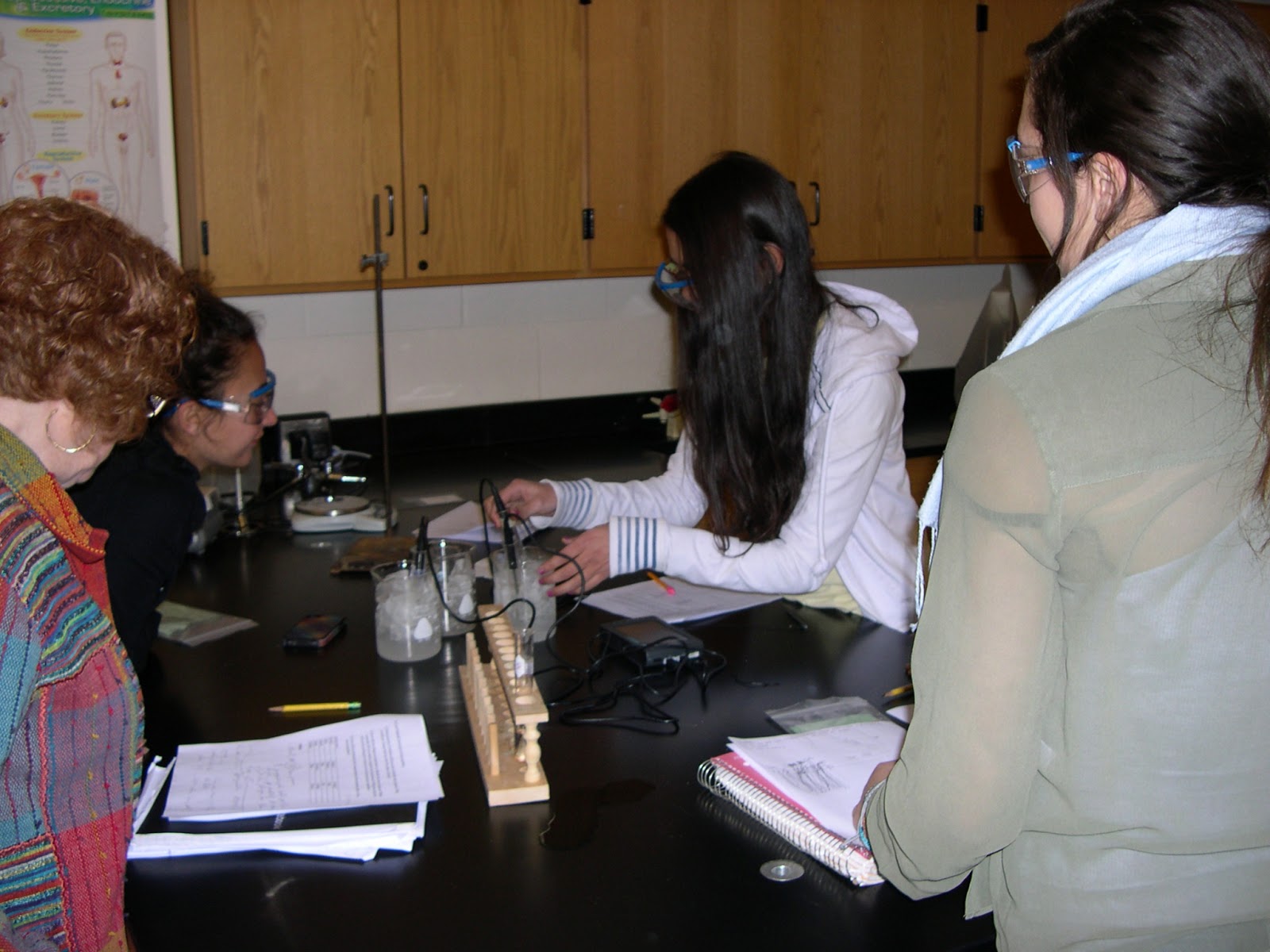
The Chem II students use differences in freezing point depression of three unknown water solutions A, B and C to determine which of the solutions contain sodium chloride, calcium chloride, and sucrose as the solute, in this lab exercise presented by Mr. Nowak.  Once that is determined they will be able to calculate the molality of each solution from the data they collected. The students do know that each solution has the same concentration.

James and Bailie use temperature probes to determine the temperature of three unknown solutions as they approach their freezing points, as Matthew and Jordan look on.

Kenny and Max look on as Mr. Nowak checks their set up.
Alina, Malika and Tatiana decided to use three separate ice baths to bring their solutions down to their freezing points, as Professor Maitland observes their technique during her classroom visit.

The Labques2t Tablet indicates each of the three probes using a different background color. The probes are showing the temperatures of the three solutions (A, B and C) as they approach their freezing points.

Wednesday, March 6, 2013

Your phone will know you're sick before you do


            One of the most difficult aspects that our health care system has to deal with is people waiting too long to do something. With the new advancements in applications and technology this problem could soon be fixed. Very soon Iphones and other smart phones will be able to monitor your statistics to a point where they know if you are sick even before you do. Spurred on  by inventions such as the Nike-fuel band or other dietary scanners that help keep you in shape before you realize how far out of shape you are. Mark Curtis who most notably founded Foursquare believes that smart phones will entirely change the healthcare system as it stands.

            He believes that the role of doctors will change due to these new applications, “They will become coaches, rather than a source of initial diagnosis.” However will the impact of this new technology be beneficial, harmful, or widely ignored? Initially, WebMD sounded like a genius idea could keep many people from the need to go to clinics; however, once it started to relate every minor bruise or issue to cancer, thee site became largely ignored. Will these new applications be more accurate? Or will they remain on the same par as just an overlooked app that was never useful? Mark Curtis believes that they will be above and beyond what the average person would expect, using science to make people constantly aware of their wellbeing. 

              In fact I have many complaints about this article; first of all, I thought upon reading the headline that the app was already out, or at least in a beta phase, or maybe they had a doctor recommendation for that app, I was let down on both guesses. The article was entirely theoretical about how a developing technology could change the medical world. But in a way it does relate to our class as we are know using our phones and tablets to record our data instead of handwriting it. In the same way people will soon be using their phones, not doctors, to check up on themselves.

posted for M. James

LINK